


Dense & Durable
A thicker, single-coat build-up gives a hard-wearing surface well suited to new-build work.
A durable, through-coloured cement-based render applied in a single main coat — a popular, efficient choice for new-build and extension work that needs a consistent, hard-wearing finish.

A fast, durable finish built for new-build and extension work.
A thicker, single-coat build-up gives a hard-wearing surface well suited to new-build work.

A single main coat is typically quicker to apply than a multi-layer build-up.

Colour is mixed through the whole render, so scuffs don’t reveal a different shade underneath.

Typically in the region of 15–25 years, depending on installation and exposure.
Monocouche — French for “single coat” — is a durable, through-coloured render applied to the required thickness and finished with a textured surface. It provides a strong, attractive and low-maintenance finish for external walls.
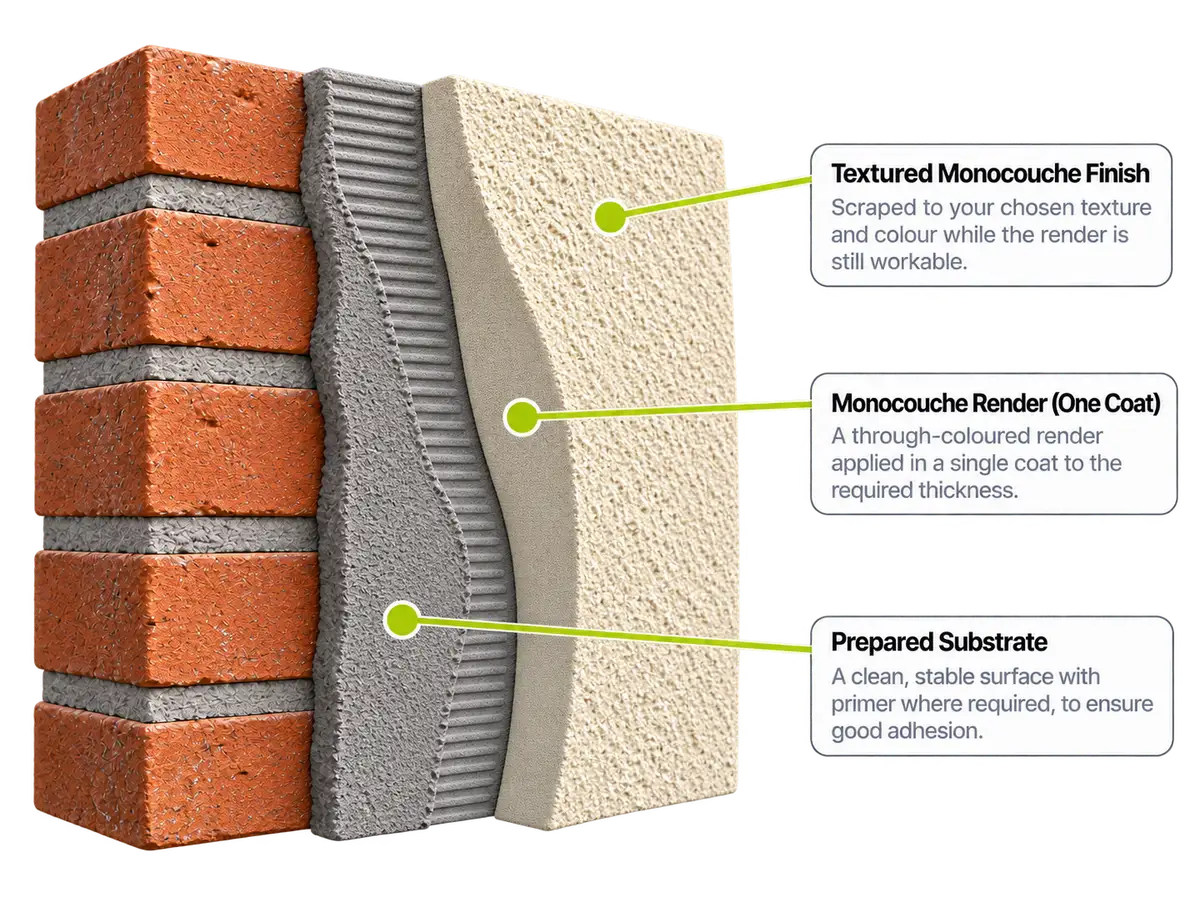
A dense, hard-wearing surface well suited to new-build and extension work.
A single-coat system can shorten the programme on larger jobs.
No separate painting stage required.
Typically 15–25 years of service life, depending on installation and exposure.
Monocouche is a factory-coloured, cement-based render designed to be applied in one main pass to a durable, consistent finish, commonly finished with a scraped or floated texture.
Because it’s typically applied at a greater thickness than thin-coat systems, it has inherent strength — and because the colour runs through the whole render, minor surface wear doesn’t show a different colour underneath.
Both are coloured exterior render systems, but they have different build-ups, finishes and strengths.
Which is better? There is no universal winner. The substrate, existing wall condition, exposure and the finish you prefer should determine the system.
A proven process for a consistent, durable monocouche finish every time.
We assess your property, recommend the right build-up and confirm access and finish options.
Surfaces are cleaned, repaired and prepared so the system has a sound, stable base.
The render is built up in one or two passes to a consistent thickness.
The surface is scraped or floated to the chosen texture while still workable.
Monocouche render is a popular default for new-build and extension work, giving a dense, durable, through-coloured finish on most standard masonry and blockwork construction.
It’s generally less flexible than silicone render, so substrate condition and preparation matter even more. If you’re still comparing finishes, see our guide to silicone render vs monocouche render.
Sometimes. The existing render must be sound, well bonded and suitable to receive the new system. We inspect the walls before recommending the build-up.
Typically in the region of 15–25 years, depending on the substrate, exposure, installation quality and maintenance.
It can be, but it’s generally less flexible than silicone render, so the condition of the substrate matters more. We assess each property before recommending it.
No — it’s through-coloured, so routine repainting isn’t normally needed to maintain the finish.
Cost depends on wall area, access, preparation needed and detailing. We provide a free quotation after reviewing the property and scope of work.
Tell us what you are considering and we will provide a clear, no-obligation quotation for the right monocouche render system and finish.


 Call
 WhatsApp
 Free Quote