

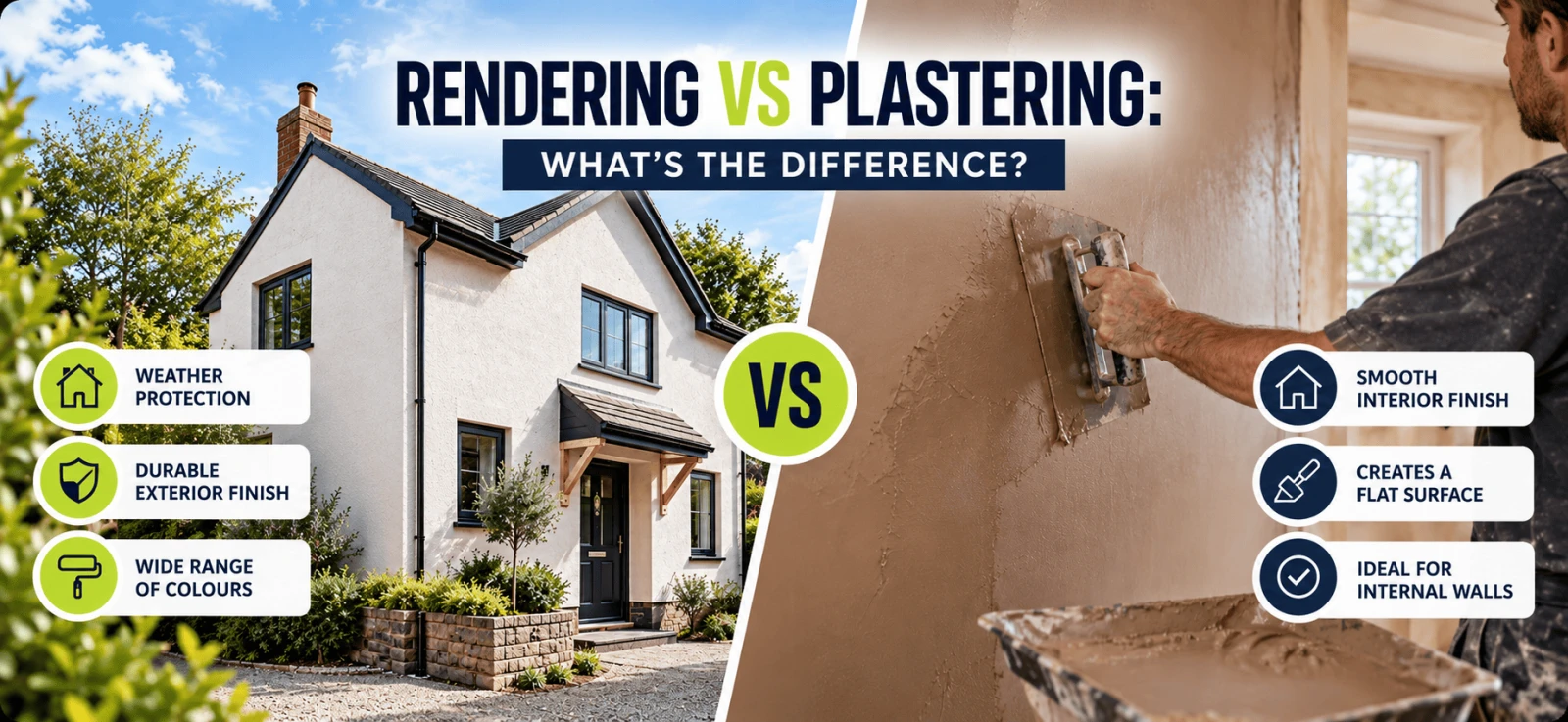
Rendering vs plastering: what's the difference?
More advice
Rendering and plastering use related skills and materials, but on a typical home they solve different problems.
Rendering is generally used on external walls to protect and finish the outside of the property. Plastering is generally used internally to create smooth walls and ceilings ready for decoration.
The distinction becomes useful when planning a renovation because the materials, preparation and weather exposure are very different.
What is rendering?
Rendering creates an external finish over a suitable wall background.
Depending on the system, it can improve appearance, provide weather protection and form part of an insulated wall build-up.
Modern options include monocouche, silicone thin-coat systems, lime render and external wall insulation with a rendered finish.
Explore our Rendering Services →
What is plastering?
Plastering is the broader term for preparing and finishing internal walls and ceilings.
A project may involve repairing failed plaster, installing plasterboard, preparing different backgrounds and then applying the final skim.
The goal is usually a smooth, consistent surface ready for decorating once the plaster has fully dried.
Explore our Plastering Services →
Why are the materials different?
External walls face rain, frost, temperature changes and sunlight, so render systems are designed for exterior exposure.
Internal plaster does not face the same weather conditions and is selected to provide a suitable interior finish.
Using the correct product for the environment is important. An exterior render is not simply “outdoor plaster”, and internal plaster should not be treated as a substitute for a designed render system.
Is skimming the same as plastering?
Skimming is part of plastering, but it is specifically the thin finishing coat applied over a suitable background.
A room that only needs skimming is therefore a different job from one that needs old plaster removing, repairs or new boards.
Read: Skimming vs Plastering: What’s the Difference? →
Can the same contractor do both?
Yes, where the contractor has experience in both types of work.
The important point is that rendering and plastering should still be approached as separate systems with their own preparation and material requirements.
For a homeowner, using one team for both can make a renovation easier to coordinate, particularly where external and internal work are happening as part of the same project.
Which job should be done first?
The sequence depends on the project.
If there are external leaks, failed render or building defects that could allow moisture into the property, those issues should be considered before fresh internal finishes are completed.
On a larger refurbishment, the renderer, plasterer and other trades should coordinate so new internal plaster is not damaged by later structural or external work.
How do the costs compare?
There is no useful one-to-one comparison because the jobs are measured and specified differently.
Rendering costs are heavily influenced by exterior wall area, scaffolding, exposure, detailing and the chosen render system.
Plastering costs depend on room size, wall and ceiling condition, preparation and whether the job is a simple skim or more extensive repair.
Read: What Affects the Cost of Rendering or Plastering? →
What finish should you expect?
A rendered elevation should provide a consistent exterior finish appropriate to the chosen system.
A plastered room should provide a smooth internal surface suitable for decorating after drying.
In both cases, the visible finish depends on the preparation beneath it, which is why the cheapest cosmetic solution is not always the best long-term approach.
How M&M can help
M&M Coloured Rendering & Plastering works across both external rendering and internal plastering.
That means we can discuss the wider condition of the property and explain which work belongs to the exterior system and which belongs to the internal finish.
Quick answer: rendering is mainly an external wall finish designed for weather exposure, while plastering is mainly an internal process used to repair and smooth walls and ceilings. They use related skills but are different systems with different materials and preparation requirements.
Related articles
Ready to get started?
Send us a few details and we'll get back to you with a free, no-obligation quote.
 Call
 WhatsApp
 Free Quote